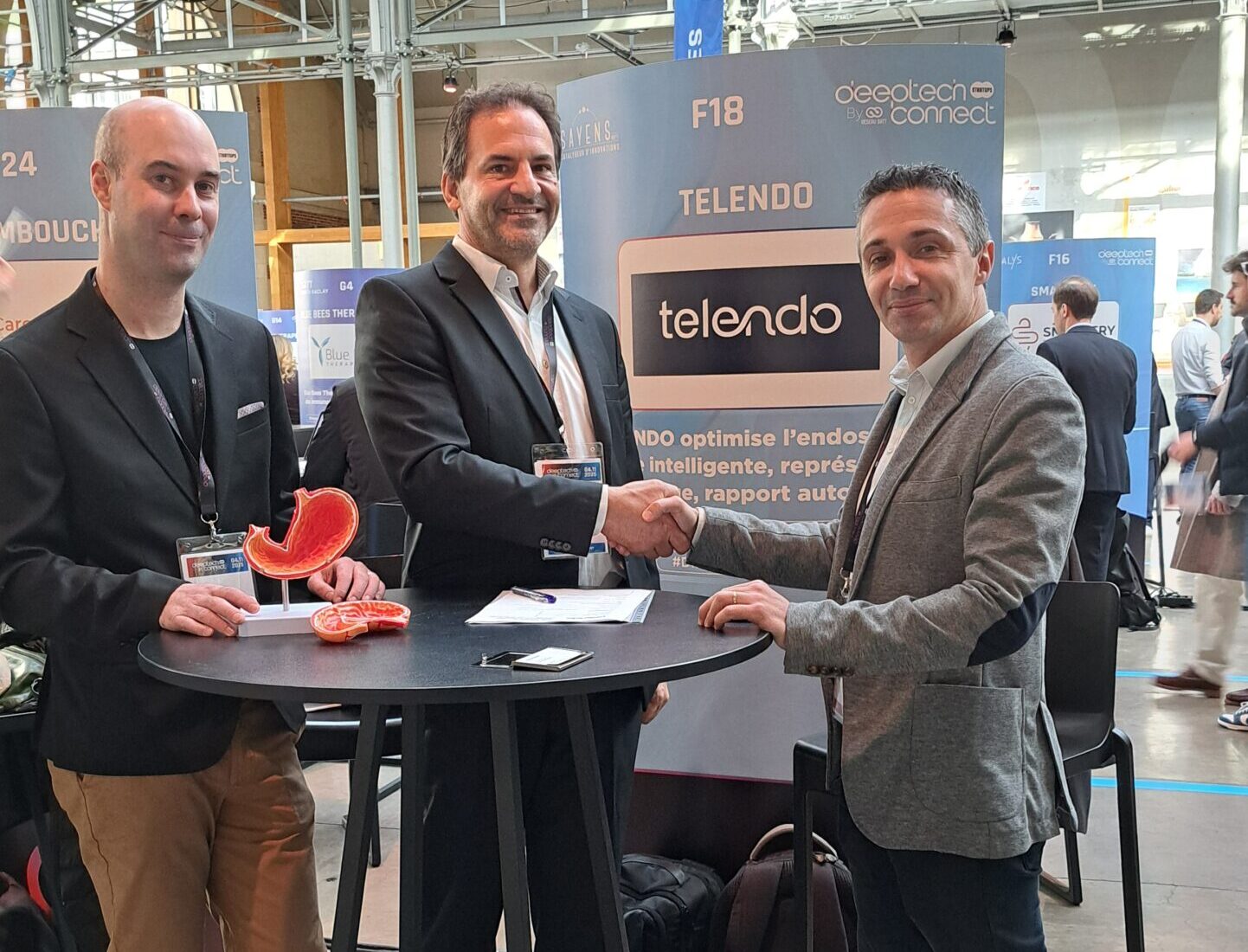
Telendo announces the signing of an exclusive licence agreement with SATT Sayens for a digital platform technology dedicated to the interpretation and enhancement of endoscopic examinations. This milestone marks a major step forward in the transfer of an innovation from public research to industry.
The technology covered by this licence is the result of joint research conducted by Professor Christian Daul, researcher Dinh-Hoan Trinh at CRAN, Thomas Bazin, gastroenterologist, and Dominique Lamarque, Professor and Hospital Practitioner in Gastroenterology at AP-HP.
By combining their complementary expertise in image processing, artificial intelligence and clinical practice, the teams have developed a technology capable of automatically capturing and structuring endoscopic video streams. A preliminary prototype has already demonstrated, under clinical conditions, the feasibility of partial 2D reconstruction of hollow organs from endoscopic videos.
This technology now forms the basis for ambitious development towards:
-
a complete 2D/3D digital reconstruction of the examined organ,
-
the integration of advanced artificial intelligence features, such as automated detection of clinical events,
-
standardisation of endoscopic data,
-
and the automation of medical documentation.
These advances pave the way for a new generation of digital tools that are more accurate, more comprehensive and fully integrated into clinical practice. They aim to improve diagnostic quality, enhance the traceability of examinations and optimise medical decision-making.

About SATT Sayens
As a Technology Transfer Acceleration Company, SATT Sayens brings promising scientific results to the fore, transforming them into innovations that meet the needs of businesses and the market, driving growth and job creation. Working alongside researchers and businesses to make science the future of innovation, Sayens has access to the skills of 6,500 researchers and 4,000 doctoral students from 140 public research laboratories across the Grand Est (Lorraine and South Champagne Ardenne-Troyes) and Bourgogne-Franche-Comté regions.
By the end of 2024: 1,083 projects identified, €42 million invested in 197 projects, 45 deep tech start-ups created, 458 intellectual property assets, a portfolio of 342 protected and de-risked technologies.